Compare Sodium Tetraborate Decahydrate (Borax Decahydrate) vs borax pentahydrate. Learn its industrial applications, physical characteristics, storage challenges and bulk procurement guidance for glass, ceramic and fertilizer manufacturers.
What Are The Differences Between Sodium Tetraborate Decahydrate and Borax Pentahydrate For Industrial Production?
When purchasing boron raw materials, procurement managers often struggle to decide between sodium tetraborate decahydrate and borax pentahydrate. Many people do not fully understand how crystal water content affects transportation costs, warehouse storage stability and final production results.
Sodium Tetraborate Decahydrate, commonly known as borax decahydrate, has the chemical formula \(\boldsymbol{Na_2B_4O_7·10H_2O}\). It is the traditional crystalline borate raw material widely used across ceramics, detergents, agriculture and fine chemical industries. This article introduces its properties, typical applications, key gaps compared with pentahydrate borax, and practical purchasing advice for factory operators.
What Core Physical Traits Does Sodium Tetraborate Decahydrate Have?
Borax decahydrate is colorless transparent crystalline powder or granular crystal.
- Contains large amounts of crystal water, leading to lower effective boron content per unit weight.
- Easy to lose crystal water under high temperature or dry environment; prone to weathering and powdering.
- Higher hygroscopic risk in humid tropical climate, which easily causes agglomeration if packaging is not well sealed.
- Excellent water solubility, dissolving rapidly in warm water to prepare boron-containing aqueous solutions.
These properties determine its suitable application scenarios and obvious limitations for large-scale continuous production.
Sodium Tetraborate Decahydrate Main Industrial Applications
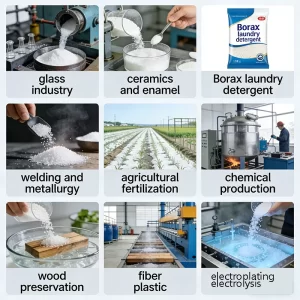
1. Ceramic & Enamel Manufacturing
Borax decahydrate acts as a low-cost fluxing agent in glaze formulas. It reduces the melting temperature of glaze, improves surface gloss, and suppresses glaze cracking during firing. It is widely adopted for medium and low-grade ceramic tiles, daily-use porcelain and enamel products.
2. Detergent & Water Treatment Auxiliaries
In laundry powder and industrial cleaning agents, it serves as water softener, pH buffer and stain dispersant. It can chelate calcium and magnesium ions in hard water to enhance cleaning efficiency. It is also used for partial wastewater pH adjustment and heavy metal stabilization.
3. Agricultural Boron Fertilizer
Dissolved borax decahydrate is a classic soluble boron fertilizer. Supplementing boron for fruit trees, vegetables and flowering crops helps reduce flower and fruit drop, improves crop pollination and boosts yield. It is favored by small and medium-sized farms due to lower unit purchase price.
4. Fine Chemical & Laboratory Raw Material
It is a basic raw material for manufacturing boric acid, borate salts, boride materials and various boron-containing chemical reagents, widely used in small-batch fine chemical synthesis.
What Are The Key Differences: Borax Decahydrate VS Borax Pentahydrate
Many factories want to know which borate fits their production line. We sort out the most practical contrasts:
- Effective Boron Content
Borax pentahydrate has higher boron concentration. When transporting equal weight cargo, decahydrate borax contains less available boron, increasing comprehensive logistics cost.
- Storage Stability
Decahydrate borax easily loses crystal water; long-term storage may cause crystal pulverization and caking. Pentahydrate borax has better anti-caking performance and adapts better to automated silo feeding.
- Suitable Production Scale
Borax decahydrate is more suitable for small-batch intermittent production and liquid solution preparation. Large glass factories and high-end ceramic manufacturers usually prefer pentahydrate borax to cut long-term freight loss.
- Formula Conversion Reminder
You cannot directly replace the two products without testing. Due to different boron content, manufacturers need to adjust dosage after lab trials to maintain stable product quality.
Storage, Packaging & Handling Guidelines
- Store sodium tetraborate decahydrate in dry, cool and ventilated warehouses. Avoid direct sunlight and high temperature to prevent weathering.
- Adopt 25kg woven bags with PE inner liner or 1000kg bulk jumbo bags. Sealing quality is critical for ocean shipping to tropical regions.
- Wear dust-proof masks and protective goggles during operation; avoid long-term inhalation of crystalline dust.
- Keep separated from strong acid substances to prevent chemical reactions.
FAQ
Q: Can borax decahydrate be used for high-end borosilicate glass production?
A: Technically feasible, but not economical. Higher crystal water means more energy consumption during glass melting. Most high-end glass manufacturers choose pentahydrate borax for continuous production.
Q: Is borax decahydrate cheaper than pentahydrate borax?
A: The unit price per ton of raw material is usually lower, but you need to calculate the cost based on effective boron content. After deducting logistics costs, the overall cost gap will shrink significantly.
Conclusion
Sodium Tetraborate Decahydrate (Borax Decahydrate) remains an economical choice for medium and low-end ceramics, detergents, agricultural boron fertilizer and small-batch fine chemical production. It provides stable performance for factories with intermittent production modes and liquid batching processes.
If you need bulk supply of high-quality sodium tetraborate decahydrate, complete COA, TDS documents and competitive quotations, contact our technical team for free samples and customized technical support.