
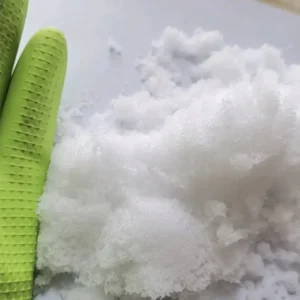
What is Ammonium Bifluoride?
Ammonium bifluoride, also known as ammonium hydrogen difluoride, formula NH₄HF₂, CAS No.1341‑49‑7, appears as white crystalline powder or flakes. It is highly hygroscopic, easily soluble in water, and its aqueous solution releases hydrofluoric‑related active components. It can etch glass, silica and silicate materials. When heated or mixed with strong acid, it decomposes and releases toxic HF and ammonia gas. The mainstream industrial purity is 98% min.
What are key industrial applications of Ammonium Bifluoride?
- Glass Industry: Frosting & Precision Etching Widely used for glass frosting, decorative engraving, scale removal on glassware, mirror and optical glass surface treatment. Compared with liquid hydrofluoric acid, it offers milder and better‑controlled etching performance in many production lines.
- Metal Surface Treatment & Pickling Applied for stainless steel, aluminum alloy descaling, removing welding oxide stains, heat‑tint residues before plating or passivation. It is popular in metal finishing workshops for controlled brightening and cleaning effect.
- Masonry & Industrial Equipment Cleaning Used for brick, concrete cleaning to eliminate efflorescence, cement film and mineral deposits. Also works for descaling boilers, heat exchangers and industrial equipment with silica‑based scale deposits.
- Electronics & Semiconductor Manufacturing High‑purity grade for silicon wafer cleaning, circuit board surface treatment and silica‑layer micro‑etching in electronic production.
- Fluorine Chemical Synthesis Important raw material for manufacturing fluoride salts, wood preservatives and other fine fluorochemical intermediates.
Which grade should you select for your production?
- 98% Industrial Grade: Most widely‑used bulk grade. Suitable for glass frosting, general metal pickling, masonry cleaning, conventional chemical synthesis, cost‑effective for large‑volume procurement.
- High‑purity / ACS Grade: Low heavy‑metal impurities. Recommended for semiconductor, electronics processing, laboratory sample digestion and high‑precision surface treatment, higher unit price.
Storage & critical safety handling guidelines
Ammonium bifluoride is corrosive and toxic. Fluoride ions may cause delayed tissue injury even if skin contact feels painless at first. Strictly follow the below rules:
- Store in cool, dry, well‑ventilated warehouse, keep package tightly sealed for moisture‑proof. Never store in glass or ordinary metal containers; HDPE / PTFE plastic containers are required.
- Keep separated from strong acid, strong alkali, oxidizing substances. Equip leakage containment area in storage zone.
- Operators must wear chemical‑resistant full‑body suit, heavy‑duty butyl rubber gloves, full‑face splash shield and dust respirator.
- On‑site must prepare calcium gluconate gel for fluoride‑burn emergency treatment. Any skin or eye exposure requires immediate flushing and mandatory medical treatment, do not ignore minor splashes.
- Standard packing: 25kg PE‑lined woven bag or plastic drum, jumbo bag available for bulk orders.
FAQ
Q1: What is the difference between Ammonium Bifluoride and Hydrofluoric Acid? A1: Ammonium bifluoride is solid crystal. When dissolved in water, it generates HF‑active species. It has lower vapor risk compared with concentrated liquid hydrofluoric acid, yet still carries fluoride toxicity hazard. They cannot be substituted arbitrarily in formulas.
Q2: Can Ammonium Bifluoride be stored in glass bottles? A2: No. It attacks silica, will corrode and damage glass containers. Only plastic or PTFE vessels are allowed for storage and transfer.
Q3: Does moisture affect ammonium bifluoride performance? A3: Yes. It is strongly hygroscopic. Moisture absorption will cause caking and partial decomposition, influencing etching and cleaning efficiency. Moisture‑proof sealing storage is essential.
Q4: Can you provide COA and MSDS for each batch? A4: Yes. Each shipment comes with Certificate of Analysis and MSDS documents, particle size can be adjusted upon customer technical requirements.