
Wondering how trisodium phosphate works for industrial water treatment, metal cleaning, detergent formulation and ceramic glazing? Explore grade specs, storage rules and bulk sourcing guide for factory buyers.
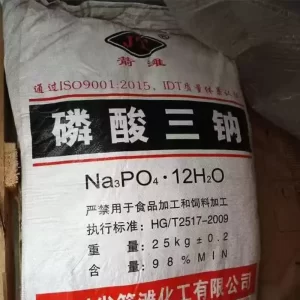
What Are The Industrial Applications & Advantages Of Trisodium Phosphate (TSP)?
Procurement specialists from water treatment plants, metal surface treatment factories, detergent manufacturers and ceramic production lines frequently ask the same question: what exactly makes trisodium phosphate (TSP) an irreplaceable multi-functional inorganic phosphate chemical.
Trisodium phosphate, short for TSP, with chemical formula \(\boldsymbol{Na_3PO_4}\), is a white crystalline phosphate salt with strong alkaline, excellent water softening and degreasing capabilities. It covers a wide range of industrial downstream scenarios, from heavy metal cleaning to boiler water conditioning. This article sorts out its core industrial functions, grade differences, safe handling standards and bulk procurement key points.
What Unique Chemical Properties Does Trisodium Phosphate Have?
- Powerful alkalinity: It can quickly raise solution pH value to neutralize acidic wastewater and remove acid rust on metal surfaces.
- Outstanding water softening capacity: Phosphate ions bind calcium and magnesium hard water ions to avoid scale precipitation on pipelines and equipment.
- Strong emulsifying & degreasing effect: Breaks down oil, grease and organic dirt for heavy-duty industrial cleaning.
- Buffer performance: Maintains stable pH value during continuous production cleaning cycles, avoiding sharp alkaline fluctuations.
Unlike carbonate salts such as soda ash, TSP combines alkalinity, scale inhibition and oil removal all in one product, simplifying factory dosing formulas.
Core Industrial Application 1: Industrial & Boiler Water Treatment
Boilers, circulating cooling water systems and factory wastewater stations are the largest consumption markets for industrial trisodium phosphate.
- Prevents limescale: Captures calcium/magnesium ions in hard water to stop hard mineral scale from sticking to boiler pipes and heat exchangers, extending equipment service life and lowering heating energy loss.
- Wastewater pH neutralization: Neutralizes acidic industrial effluent from metal plating, mining and chemical workshops to meet environmental discharge standards.
- Corrosion inhibition: Forms a thin protective phosphate film on steel pipeline inner walls to slow metal rusting.
Core Industrial Application 2: Metal Surface Degreasing & Pre-Treatment
Metal processing, automobile parts, hardware and electroplating factories widely use TSP as main degreasing agent:
- Removes cutting oil, anti-rust grease and polishing wax on steel, aluminum and iron workpieces before painting, electroplating or powder coating.
- Cleans surface dirt evenly without causing over-corrosion to metal substrates when prepared into standard cleaning solution.
- Compared with single soda ash cleaning agents, TSP achieves better oil removal efficiency under low-to-medium temperature, cutting heating costs for continuous cleaning lines.
Core Industrial Application 3: Detergent & Cleaning Compound Formulation
Industrial heavy-duty laundry detergents, industrial floor cleaners and degreasing sprays take TSP as a key builder:
- Softens hard washing water to boost surfactant cleaning power.
- Disperses dirt particles to prevent redeposition of oil and stains back onto cleaned surfaces.
- Widely used for textile printing & dyeing auxiliary to remove fabric sizing oil before coloring.
Core Industrial Application 4: Ceramic Glaze & Enamel Production
In ceramic and enamel manufacturing, food-grade and industrial-grade trisodium phosphate acts as a suspension agent for glaze slurry:
- Stabilizes glaze particle dispersion, preventing solid pigment sedimentation in storage tanks.
- Improves glaze fluidity during spraying, making the glaze coating thickness uniform on tiles and sanitary ware.
- Adjusts slurry viscosity to reduce glaze waste during automatic glazing operations.
Safe Storage & Handling Guidelines For Trisodium Phosphate
- TSP is strongly alkaline; avoid direct contact with skin, eyes and respiratory tracts. Operators must wear protective gloves, goggles and dust masks during powder feeding.
- Store in dry, sealed warehouses to prevent moisture absorption and caking; separate from acidic chemicals to avoid violent neutralization reactions.
- Do not mix with ammonium salts, as the reaction will release irritating ammonia gas that harms workers.
- Pack with moisture-proof PE inner liner inside woven bags for long-distance sea transportation to keep good free-flow performance.
FAQ
Q: What is the difference between food grade and industrial grade trisodium phosphate?
A: Industrial TSP focuses on degreasing and water treatment with slightly higher heavy metal limits. Food grade TSP undergoes strict heavy metal purification, complying with food additive standards for food processing and dairy equipment cleaning.
Q: Can soda ash replace trisodium phosphate for boiler anti-scaling treatment?
A: Soda ash only provides alkalinity, lacking scale chelation function. TSP can both adjust pH and lock hard water ions, so soda ash cannot fully substitute it for boiler scale prevention.
Conclusion
Trisodium phosphate (TSP) integrates water softening, degreasing, pH adjustment and anti-scaling functions, making it an essential multi-purpose raw material for water treatment, metal processing, detergent and ceramic industries.
If you need industrial or food grade trisodium phosphate with stable purity, complete COA certification and customized bulk packaging, contact our technical sales team for free test samples and factory-direct quotations.