
Discover key industrial uses of boric acid for borosilicate glass, ceramic glaze, electroplating and preservative formulation. Learn its chemical features, storage rules and bulk sourcing guidance for factory procurement teams.
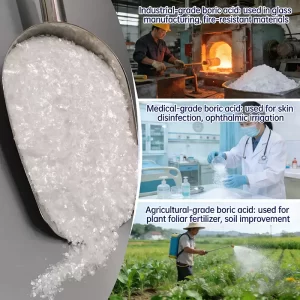
What Industrial Applications & Technical Advantages Does Boric Acid Offer For Glass, Ceramic & Fine Chemical Manufacturing?
Procurement engineers from glass factories, ceramic workshops, electroplating plants and fine chemical manufacturers often ask: when should we select boric acid instead of borax as boron source raw material?
Boric Acid, chemical formula \(\boldsymbol{H_3BO_3}\), is a white, flaky crystalline boron compound. As a fundamental boron chemical raw material, it delivers unique weak acid fluxing and anti-mold properties that borax cannot replicate in many production formulas. This article explains its core characteristics, mainstream industrial applications, comparison with borax, and safe bulk handling suggestions.
What Unique Chemical Properties Does Boric Acid Have?
- Mild weak acidity: Boric acid provides gentle acidic environments without strong corrosivity, suitable for delicate raw material synthesis and surface treatment.
- Excellent fluxing effect at medium-high temperature: It lowers melting point of silicate raw materials in glass and ceramic formulas.
- Good solubility in hot water, easy to prepare homogeneous aqueous solutions for liquid phase production processes.
- Natural bacteriostatic and anti-fungal performance, widely applied in anti-corrosion and preservation scenarios.
Unlike borax (sodium borate), boric acid contains no sodium ions. This feature makes it irreplaceable for sodium-free production requirements.
Core Industrial Application 1: Special Glass & Fiberglass Manufacturing
The glass industry consumes the largest share of industrial-grade boric acid.
- Essential raw material for borosilicate heat-resistant glass, laboratory glassware, optical glass and glass fiber.
- It improves thermal shock resistance, chemical corrosion resistance and mechanical strength of finished glass.
- Without introducing sodium impurities, boric acid avoids light scattering and haze problems for high-end transparent glass products.
Core Industrial Application 2: Ceramic, Enamel & Glaze Production
Ceramic tile, sanitary ware and art ceramic factories add boric acid into glaze formulations:
- Acts as flux to reduce firing temperature and save kiln fuel consumption.
- Improves glaze surface gloss, flatness and reduces pinholes, cracks and glaze crazing defects.
- Widely used for low-sodium high-grade ceramic glaze where borax will cause undesirable sodium contamination.
Core Industrial Application 3: Electroplating & Metal Surface Treatment
Boric acid is a standard buffering agent for nickel electroplating and many electroplating bath systems:
- Stabilizes pH value of plating solution, prevents drastic pH fluctuation during continuous electroplating production.
- Promotes uniform metal deposition, helping form smooth, compact plating layers and reducing surface blemishes on metal workpieces.
Core Industrial Application 4: Fine Chemical, Preservative & Other Industries
- Wood & Textile Anti-mold Agent: Plays fungicidal and flame retardant roles in timber treatment, textile fiber processing.
- Cosmetic & Pharmaceutical Intermediates: Purified grades serve as raw materials for external ointments and mild antiseptic products.
- Borate Raw Material Intermediate: The basic feedstock to produce borax, lithium borate and other advanced boron chemicals.
Boric Acid VS Borax: How To Choose Suitable Boron Raw Material?
Many buyers confuse boric acid with borax pentahydrate / decahydrate. The most critical distinction lies in sodium content:
- Boric Acid: Sodium-free. Ideal for optical glass, high-end ceramic glaze and electroplating baths that prohibit sodium ion contamination.
- Borax (Sodium Tetraborate): Contains sodium. More cost-effective for ordinary glass, common ceramic, detergent and agricultural fertilizer formulas.
Formula adjustment reminder: Direct one-to-one replacement is not feasible. Factories must carry out small batch trial production to adjust dosing amount.
Safe Storage & Operation Guidelines For Boric Acid
- Store boric acid in dry, cool and ventilated warehouses. Seal packaging tightly to prevent moisture absorption and agglomeration.
- Avoid mixing with strong alkalis; neutralization reaction will occur when contacting soda ash, potassium carbonate and other alkaline chemicals.
- Wear dust masks and protective goggles during handling. Avoid long-term inhalation of crystalline dust, and prevent accidental oral intake.
- Standard bulk packaging: 25kg woven bags with PE inner liner or 1000kg jumbo bags for sea transportation.
FAQ
Q: Can boric acid completely replace borax pentahydrate in ceramic glaze?
A: It depends on formula requirements. If the finished product cannot accept sodium ions, boric acid is the better option. If cost control is the priority for regular ceramics, borax pentahydrate is more economical.
Q: What is the difference between industrial grade and refined boric acid?
A: Refined grade has stricter control over heavy metal and insoluble impurities, applicable for optical glass, pharmaceutical and cosmetic raw materials. Industrial grade meets general glass, common ceramic and electroplating production demands.
Conclusion
Sodium-free boric acid remains an indispensable boron raw material for high-end heat-resistant glass, optical glass, premium ceramic glaze and electroplating industries. Its mild acidity and excellent flux performance solve many technical problems that sodium-containing borax cannot handle.
If you need stable bulk supply of industrial or refined grade boric acid, complete COA and TDS documents, as well as factory competitive quotations, contact our technical sales team for free test samples.