
Wondering about antimony trioxide’s flame retardant synergist performance, purity grades (99.5% /99.8% /99.9%), plastic/glass/ceramic applications, storage safety and bulk sourcing tips for factory buyers.
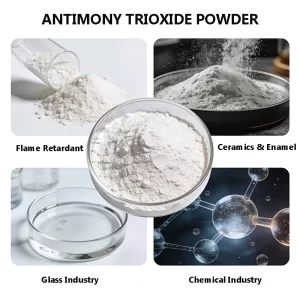
What Are Industrial Applications & Grade Specifications Of Antimony (III) Oxide (Antimony Trioxide, Sb₂O₃)?
Procurement engineers for plastic masterbatch factories, cable rubber manufacturers, glass melting plants and ceramic glaze workshops frequently raise this question: why Antimony (III) Oxide (also known as Antimony Trioxide, Sb₂O₃ or antimony white) is the most widely used halogen flame retardant synergist worldwide, and which purity grade matches different production lines.
Antimony Trioxide, chemical formula \(\boldsymbol{Sb_2O_3}\), CAS No.1309-64-4, is a fine, bright white amphoteric inorganic powder with two crystal forms: cubic senarmontite and orthorhombic valentinite. It features unique halogen synergistic flame retardant effect, excellent high-temperature stability and outstanding whitening & clarifying performance for glass and ceramics. This article covers its core physical features, mainstream purity grades, full industrial application fields, safe operation standards and purchasing selection guide.
1. Core Physical & Chemical Properties of Antimony Trioxide
- Stable high-temperature resistance: Melting point at 656°C, sublimates at 1550°C, no decomposition under common polymer extrusion and glass firing temperatures.
- Powerful halogen synergistic flame retardancy: It cannot achieve ideal fire resistance alone, but forms high-efficiency flame retardant systems when mixed with brominated/chlorinated flame retardants, reaching UL94 V-0 standard with low addition dosage.
- Amphoteric oxide trait: Insoluble in water and weak acid, soluble in concentrated hydrochloric acid, strong alkali and tartaric acid, stable in most resin and glaze formulas.
- High whiteness & hiding power: Fine uniform powder delivers pure white tone, serving as whitening and clarifying agent for glass and ceramic glazes.
- Low heavy metal impurity in high-purity grades: Ultra-low lead, iron, arsenic content avoids color spots on finished products.
2. Main Industrial Purity Grades & Their Suitable Scenarios
Global bulk supply divides antimony trioxide into three mainstream industrial specifications based on Sb₂O₃ purity:
Grade 1: 99.5% Purity (General Industrial Grade)
- Impurity limit: Sb₂O₃ ≥99.5%, moderate trace iron & arsenic
- Best for: Ordinary PVC plastic, general rubber, low-end fireproof coating, common ceramic tiles, cost-sensitive mass production lines.
Grade 2: 99.8% Purity (Standard High-Grade, Most Popular)
- Impurity limit: Sb₂O₃ ≥99.8%, strictly controlled heavy metal impurities
- Best for: Engineering plastics (ABS, PBT), wire & cable rubber, architectural fire retardant coating, daily-use enamel, regular glass clarification. This is the universal grade for 80% global manufacturers.
Grade 3: 99.9% Purity (Ultra-High Purity Electronic/Optical Grade)
- Impurity limit: Sb₂O₃ ≥99.9%, ultra-low As, Pb, Fe, Cu, Bi heavy metal residues
- Best for: Optical photovoltaic glass, electronic varistor ceramics, high-grade cosmetic pigments, PET fiber catalyst, premium art ceramic glaze with zero stain requirement.
3. Core Industrial Application 1: Flame Retardant Synergist for Plastics & Rubber (Largest Consumption Field)
Antimony trioxide dominates polymer fire protection industry, widely matched with brominated flame retardants for all halogen-containing plastic formulas:
- Hard & Soft PVC Products: Plastic pipe, window profiles, plastic film, artificial leather, PVC cable insulation and sheath. Low addition rate maintains material tensile strength while meeting fire safety standards.
- Engineering Plastics: ABS, PP, PE, PS, PA, PBT plastic masterbatch, electronic equipment plastic housings, automotive interior plastic parts.
- Rubber Industry: Mine conveyor belts, fire-resistant rubber hoses, wire rubber insulation, sealing rubber gaskets, stops rubber combustion and reduces toxic smoke release during fire.
- Textile & Synthetic Fiber: Polyester, nylon fabric flame retardant finishing, prevents textile rapid burning for furniture fabrics and safety protective cloth.
- Fireproof Coatings & Paints: Steel structure anti-fire paint, building interior fire retardant coating, forms dense carbonized protective layer to isolate oxygen and heat when burning.
Flame Retardant Working Mechanism
During combustion, Sb₂O₃ reacts with halogen compounds to generate volatile antimony halide gas, which captures high-energy free radicals to cut off flame combustion chain reaction. Meanwhile, it promotes the formation of dense carbon film on material surface to block heat and oxygen transmission, realizing dual solid-gas phase flame suppression.
4. Core Industrial Application 2: Clarifier & Whitening Agent for Glass & Photovoltaic Industry
High-purity antimony trioxide is essential auxiliary raw material for glass melting:
- Eliminates tiny microbubbles trapped inside molten glass, greatly improving light transmittance of float glass, daily glass and photovoltaic panel glass.
- Acts as decolorizer to neutralize yellow-green tint caused by iron impurities in glass raw ore, presenting bright clear glass appearance.
- Stable performance under long high-temperature kiln firing, no residual colored impurities left inside finished glass.
5. Core Industrial Application 3: Ceramic, Enamel & Inorganic Pigment Production
- Ceramic & Enamel Glaze Additive: Works as covering whitening agent and flux, improves glaze surface smoothness, gloss and opacity, prevents glaze pinholes and discoloration after kiln firing for sanitary ware, floor tiles and art porcelain.
- High-Temperature Inorganic Pigment Raw Material: Key feedstock to produce heat-resistant composite pigments such as nickel titanate yellow and chrome titanate brown, with outstanding light fastness and weather resistance for high-grade coating and plastic color matching.
6. Other Widely Used Industrial Scenarios
- PET Polyester Catalyst Auxiliary: Accelerates polyester polymerization reaction and eliminates micro-air bubbles inside fiber melt.
- Petrochemical Passivation Agent: Used in heavy oil catalytic cracking & reforming processes to protect catalyst activity and extend service life.
- Electronic Functional Ceramics: Raw material for pressure-sensitive ceramic components and magnetic head non-magnetic ceramic parts in electronic devices.
Antimony Trioxide VS Antimony Pentoxide: Quick Selection Distinction
Many buyers confuse trivalent and pentavalent antimony oxide; here is clear differentiation for procurement reference:
- Antimony Trioxide (Sb₂O₃, Sb³⁺): Lower unit cost, best for high-temperature extrusion plastic, glass and ceramic production; mainstream bulk industrial flame retardant synergist.
- Antimony Pentoxide (Sb₂O₅, Sb⁵⁺): Ultra-fine aqueous dispersion powder, only suitable for low-temperature water-based coating, textile liquid finishing; higher market price and narrow application range.
- Selection Rule: Choose Sb₂O₃ for solid plastic masterbatch, glass and kiln ceramic production; pick Sb₂O₅ only for waterborne liquid flame retardant formulas.
Safe Storage, Transportation & Operation Guidelines
- Storage rules: Keep in dry, cool, well-ventilated warehouses, use 25kg PE lined woven bags or 1000kg jumbo bags with tight sealing to avoid moisture absorption and powder caking. Separate storage from strong acid chemicals to prevent chemical reactions.
- Operation protection: Wear dust-proof respirators, safety goggles and rubber gloves during feeding and mixing; avoid long-term inhalation of fine antimony white dust.
- Shipping regulation: Classified as UN 1549 hazardous goods, follow international dangerous chemical ocean transport standards for overseas bulk shipment.
- Waste disposal: Do not dump waste antimony trioxide directly; collect residual powder for centralized professional hazardous waste treatment in accordance with local environmental protection regulations.
FAQ
Q1: Can antimony trioxide realize flame retardant effect without halogen additives?
A1: No. Its flame retardant performance depends on synergistic reaction with bromine/chlorine compounds. Alone adding Sb₂O₃ cannot reach qualified fire resistance rating.
Q2: Why choose 99.9% ultra-high purity antimony trioxide for photovoltaic glass?
A2: Trace heavy metal impurities such as iron and arsenic will form colored spots inside photovoltaic glass and reduce light transmittance, lowering solar panel power generation efficiency. 99.9% grade strictly limits all harmful heavy metal residues to guarantee glass clarity.
Q3: Will antimony trioxide affect the mechanical properties of plastic products?
A3: Proper dosage (3%-8% of total plastic formula) has negligible influence on plastic tensile and impact strength. Excessive addition will slightly reduce material toughness, so formula proportion needs factory lab trial adjustment.
Conclusion
As a multi-functional inorganic industrial raw material, antimony (III) oxide combines powerful halogen synergistic flame retardancy, glass clarifying capacity and ceramic whitening performance. Three purity grades (99.5% /99.8% /99.9%) match low-cost mass production, standard universal manufacturing and high-end optical/electronic precision production lines respectively.
If you need factory-direct bulk supply of antimony trioxide with customized purity grades, complete COA & TDS certificates, hazardous goods shipping documents and competitive factory quotations, contact our technical sales team for free lab test samples and formula matching guidance.