
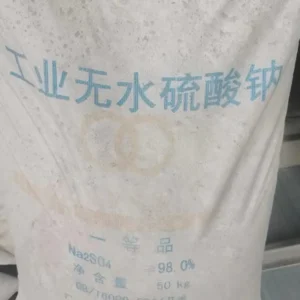
Anhydrous Sodium Sulfate (Salt Cake, Na₂SO₄) is a common industrial inorganic salt. Learn its purity grades, core applications in glass, detergent, textile, papermaking, storage safety and professional procurement tips for factory buyers.
Q1: What is Anhydrous Sodium Sulfate?
Anhydrous Sodium Sulfate, commonly called Salt Cake, chemical formula Na₂SO₄, CAS No. 7757-82-6, is a white anhydrous inorganic crystalline powder or granular solid. It contains no crystal water, features stable chemical properties, good water solubility, and neutral pH value. Different from mirabilite (hydrous sodium sulfate), industrial anhydrous sodium sulfate maintains stable particle state and does not easily weather or lose weight during storage and transportation. It is one of the most cost-effective bulk industrial inorganic salts widely used in basic manufacturing industries.
Q2: What are the mainstream industrial purity grades?
Global industrial supply mainly divides anhydrous sodium sulfate into two standard grades according to purity and impurity control:
1. Standard Industrial Grade (≥98.5%)
Economical general-purpose grade with qualified impurity indicators. Suitable for low-to-medium standard mass production such as detergent filling, ordinary textile dyeing and common building materials.
2. High Purity Industrial Grade (≥99.2% / 99.5%)
Strictly control chloride, iron, water-insoluble matter and moisture content. Ideal for high-end glass melting, fine chemical synthesis, precision textile printing and dyeing, and papermaking industry with strict quality requirements.
Q3: What are the core industrial applications?
1. Glass Industry (Core High-End Application)
Anhydrous sodium sulfate acts as a high-efficiency glass refining and defoaming agent during glass melting. It eliminates micro bubbles and streaks in molten glass, improves melt fluidity, and enhances glass transparency and yield rate. Widely used in float glass, daily container glass, architectural glass and decorative glass production.
2. Detergent & Surfactant Industry
It is the main filler and diluent for washing powder and industrial detergents. It improves powder fluidity, prevents agglomeration, reduces production costs, and stabilizes detergent formula performance. It is the largest consumption scenario for low-grade sodium sulfate.
3. Textile Printing & Dyeing
Used as a dye levelling agent and salt agent in textile dyeing. It promotes uniform dye adsorption on fabric fibers, improves dyeing rate and color fastness, and avoids color difference and uneven coloring problems. Suitable for cotton, linen and chemical fiber dyeing processes.
4. Papermaking Industry
Applied in pulp cooking and paper surface treatment to improve paper density, smoothness and folding resistance, and optimize papermaking process conditions.
5. Chemical Raw Material Production
Basic raw material for manufacturing sodium sulfide, sodium silicate, sulfate salts and other fine chemical products, widely used in chemical auxiliary processing.
6. Other Industrial Scenarios
Used in electroplating additives, mineral flotation agents, battery auxiliary materials and cement early-strength agents for industrial production.
Q4: What is the difference between Anhydrous Sodium Sulfate and Mirabilite?
Many buyers confuse anhydrous sodium sulfate with hydrous mirabilite:
– Anhydrous Sodium Sulfate (Na₂SO₄): No crystal water, stable quality, no weathering, high effective content, suitable for high-temperature processes such as glass melting.
– Mirabilite (Hydrous Sodium Sulfate): Contains 10 crystal water, easy to weather, lose weight and agglomerate, only suitable for low-temperature ordinary dyeing and detergent filling.
Glass factories and high-standard production lines must choose anhydrous grade only.
Q5: How to store and handle Anhydrous Sodium Sulfate safely?
– Store in dry, cool and well-ventilated warehouse, keep tightly sealed to prevent moisture absorption and caking.
– Keep away from strong acids, oxidants and humid environment.
– Wear ordinary dust masks and gloves during operation, avoid long-term inhalation of dust.
– Non-dangerous goods for sea transportation, easy for bulk container shipment.
– Standard packaging: 25kg woven bag with PE inner liner, 1000kg jumbo bag for bulk order.
Q6: How to select the right grade for bulk purchasing?
– Detergent, ordinary textile dyeing, low-cost industrial filling: Choose 98.5% standard industrial grade for cost performance.
–Glass refining, high-end textile, papermaking, fine chemical: Choose 99.2%~99.5% high-purity grade to avoid impurity defects.
– Focus on moisture content and water-insoluble matter indicators, which are the key factors affecting product stability.
FAQ
Q1: Does anhydrous sodium sulfate absorb moisture easily?
A1: It has slight hygroscopicity. Long-term exposure to humid air will cause caking. Sealed dry storage can completely avoid quality problems.
Q2: Can anhydrous sodium sulfate replace mirabilite in all formulas?
A2: Yes, anhydrous grade has higher purity and more stable performance. But due to higher cost, most low-end factories still choose mirabilite for cost control.
Q3: Will high iron content affect glass quality?
A3: Yes. Excess iron impurities will cause green tint and reduce glass transparency. High-purity low-iron sodium sulfate is mandatory for high-transparent glass production.
Q4: Can you provide complete COA and MSDS documents?
A4: Yes. Every batch is equipped with official COA, MSDS and customs declaration documents to support global bulk export.
Conclusion
Anhydrous Sodium Sulfate (Salt Cake) is an indispensable basic inorganic chemical in modern industry. With stable chemical performance and wide applicability, it serves as core auxiliary material for glass defoaming, detergent processing and textile dyeing. Choosing matched purity grade according to production scenarios can effectively balance product quality and procurement cost. For stable bulk supply and customized technical support, contact our sales team for free samples and factory quotations.