
What is Glass Refining Agent?
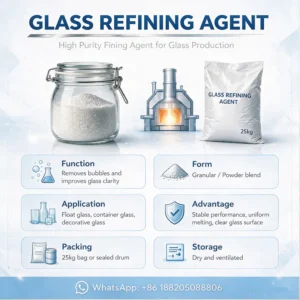
Glass refining agent, also called glass clarifier, is a key functional additive for glass melting process. When added into glass batch materials, it decomposes at high temperature inside glass melt, generates a large amount of gas, expands small bubbles inside molten glass, makes bubbles rise and escape from glass liquid. It effectively removes air bubbles, blisters and seeds defects, improving glass transparency, surface smoothness and finished‑product yield.
How does glass refining agent work during glass melting?
At high melting temperature, the refining agent undergoes thermal decomposition and releases large‑volume gas. These gases merge with tiny micro‑bubbles trapped in molten glass. With increased bubble volume, buoyancy rises and bubbles float up to the glass liquid surface and escape. After refining treatment, the glass liquid becomes homogeneous, and bubble defects are greatly reduced. Different clarifiers take effect within different temperature ranges according to their chemical properties.
What are the mainstream types of glass refining agents on the market?
- Antimony‑based Refining Agent (Antimony Trioxide) Popular for flat glass, container glass and decorative glass. Works within medium‑high temperature range, excellent clarifying performance, stable finished glass quality. Usually matched with oxidizing agents in batch formula.
- Cerium‑based Refining Agent (Cerium Oxide) Environment‑friendly rare earth clarifier. Low heavy‑metal risk. Widely used for high‑grade glass, optical glass, cosmetic glassware. Features good refining effect plus decolorizing function.
- Sodium Antimonate Suitable for alkali‑rich glass systems. Good oxidation‑refining performance, commonly used for daily‑use glass and colored glass production.
- Sulfate‑based Refining Agent (Sodium Sulfate) Cost‑effective bulk refining material, mostly applied for float glass and building glass. Requires strict control of melting atmosphere to avoid sulfur‑related defects.
- Composite Glass Refining Agent Custom blended multi‑component product. Combine advantages of multiple raw materials, adapt to special glass formulas, simplify batching operation for glass factories.
How to choose suitable glass refining agent for your production?
- Ordinary building glass & float glass: Prefer sulfate‑based low‑cost refining agent, focus on large‑batch stable supply.
- Daily‑use container glass, beverage bottle glass: Antimony trioxide is the mainstream choice, balance refining efficiency and production cost.
- High‑end cosmetic glass, optical glass, art glass: Choose cerium oxide or composite rare‑earth clarifier for low‑defect and environmental‑friendly requirements.
- Special colored glass: Select sodium antimonate or custom composite refining agent according to glass base formula and color system.
Key usage & storage recommendations
- Add dosage strictly follow formula requirements; excessive addition may trigger new defects such as haze or discoloration.
- Mix evenly with other raw batch materials before feeding into furnace.
- Store in cool dry warehouse, keep sealed and moisture‑proof. Keep separate from acid and oxidizing chemicals.
- Standard packing: 25kg woven bag with PE inner liner, jumbo bag available for large‑scale glass plant orders.
FAQ
Q1: Can decolorizer replace glass refining agent? A1: No. Decolorizer removes undesired color caused by impurities. Refining agent eliminates bubbles. They serve completely different functions, cannot substitute each other. Many glass formulas use both together.
Q2: Will melting temperature affect clarifying performance? A2: Yes. Every refining agent has its own effective working temperature window. If furnace temperature is too low, decomposition will be insufficient and bubble removal will be poor. Too high temperature may cause volatilization loss.
Q3: What causes residual bubbles even after adding refining agent? A3: Possible reasons include improper dosage, uneven raw material mixing, unreasonable furnace temperature curve or bad melting atmosphere. Need to check whole production process instead of only adjusting clarifier amount.
Q4: Can you supply custom composite glass refining agent according to our glass formula? A4: Yes. We can develop customized composite refining agent based on your glass type, furnace condition and existing batch formula. COA and MSDS documents are provided for each batch.