
Compare rutile vs anatase titanium dioxide on crystal structure, weather resistance, hiding power, industrial application fields and market price gaps. Learn how to select the suitable TiO2 pigment for your coating, plastic or paper production line.
What Are The Differences Between Rutile and Anatase Titanium Dioxide? Applications, Weather Resistance & Price Comparison
Factory procurement engineers from coating, plastic, ink and paper industries frequently face a critical purchasing question: should we buy rutile titanium dioxide or anatase titanium dioxide? Many buyers only know there is a price gap between the two types, but they fail to understand how crystal structure, weather resistance and hiding power affect finished product quality and long-term production costs.
This article systematically compares rutile TiO₂ and anatase TiO₂ from core physical properties, applicable industrial fields, performance limits and market price differences, helping you make cost-effective raw material selection decisions.
1. Core Crystal & Physical Performance Differences
The fundamental gap between the two pigments originates from their distinct crystal lattice structures, which leads to totally different industrial performance:
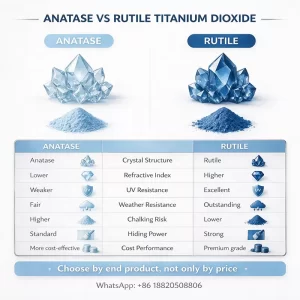
| Comparison Item | Rutile Titanium Dioxide | Anatase Titanium Dioxide |
|---|---|---|
| Crystal Structure | Dense rutile lattice, high refractive index | Loose anatase lattice, low refractive index |
| UV Resistance & Weatherability | Excellent UV shielding, anti-chalking, anti-yellowing for long-term outdoor exposure | Poor weather resistance; UV light triggers chalking, fading and yellowing |
| Hiding & Tinting Power | Strong hiding power, low addition dosage required | Weak hiding power, higher mixing proportion to reach equal opacity |
| Photocatalytic Activity | Very low, stable color retention | High photocatalysis, decomposes organics under UV light |
| Initial Whiteness | Slight warm white undertone | Bright snow-white, purer white tone |
| Dispersibility | Silica/alumina coated grades disperse well in solvent & water-based resin | Better hydrophilicity, easier dispersion in water-based pulp & indoor paint |
Key Summary
Rutile TiO₂ is engineered for durability and outdoor anti-aging; anatase TiO₂ focuses on bright whiteness, low cost and photocatalytic functions for fully enclosed indoor environments.
2. Separate Industrial Application Directions
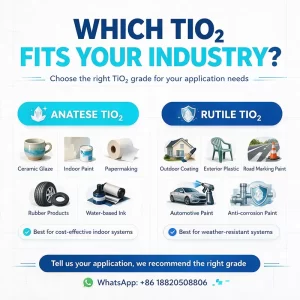
2.1 Main Application Scenarios of Rutile Titanium Dioxide
All products that require long-term outdoor service life and anti-fade performance must choose rutile grade:
- Outdoor Coatings: Exterior wall paint, anti-corrosion industrial paint, automotive topcoat, marine protective coating, road marking paint.
- Outdoor Plastic & Masterbatch: PVC window profiles, agricultural plastic film, outdoor furniture plastic, exterior plastic injection parts.
- Long-Lasting Printing Ink: Outdoor advertising ink, automotive paint ink, metal surface printing ink.
- High-Grade Ceramic & Cosmetics: Weather-resistant ceramic glaze, sunscreen cosmetics for UV physical shielding.
2.2 Main Application Scenarios of Anatase Titanium Dioxide
Only suitable for fully indoor, UV-free closed production environments and photocatalytic materials:
- Paper Industry: Coated art paper, wallpaper, cigarette paper, printing paper (largest consumption field of anatase TiO₂).
- Indoor Water-Based Coatings: Interior latex wall paint, furniture primer, indoor decorative water paint.
- Food & Daily Consumer Goods: Food-contact plastic tableware, toothpaste, mild skincare cream, medical ointment additives.
- Photocatalytic Environmental Materials: Air purification filter media, sewage degradation agents, self-cleaning indoor coatings.
- Textile Fiber Delustering Agent: Polyester, nylon matte fiber spinning additive.
Critical Usage Taboo
Never use anatase TiO₂ for any outdoor products. Continuous sunlight exposure will cause paint film cracking, plastic yellowing and serious customer complaints within 1–2 years.
3. Market Price Gap & Cost Analysis
3.1 Current Global Bulk Price Difference
- Unit ton price: Rutile titanium dioxide is generally 20%–40% higher than anatase grade in international bulk chemical markets.
- Reason for price gap:
- Rutile ore raw material cost is higher;
- Complex multi-layer inorganic surface coating process (silica, alumina, zirconia) increases production energy and labor expense;
- Strict quality control for weather resistance and low impurity standards.
3.2 Comprehensive Production Cost Calculation Tips
Do not judge cost only by single ton price:
- Rutile TiO₂ has stronger hiding power, so factories add 20%–30% less pigment in formulas. For large outdoor coating production lines, the actual comprehensive raw material cost gap shrinks significantly.
- Anatase has obvious advantages for mass indoor paper and interior paint factories: low unit price, high whiteness demand and no outdoor durability requirements, bringing clear cost savings.
- For photocatalytic material manufacturers, anatase is the only viable option, and rutile cannot replace it at any price.
4. Quick Selection Checklist For Procurement Teams
Choose Rutile Titanium Dioxide If:
- Your finished products will be used outdoors under direct sunlight;
- You need long-term anti-chalking, anti-yellowing and anti-aging performance;
- You produce automotive paint, exterior plastic, marine coating or outdoor advertising ink;
- Your formula requires strong hiding power to reduce pigment addition rate.
Choose Anatase Titanium Dioxide If:
- All finished goods are used indoors without long-term UV exposure;
- You produce coated paper, interior latex paint, food-grade plastic or photocatalytic purification materials;
- Bright snow-white appearance is the core demand, and cost control is a top priority;
- Your production line uses water-based pulp or low-temperature indoor waterborne systems.
FAQ
Q1: Can I mix rutile and anatase titanium dioxide in one formula to balance cost and weather resistance?
A1: Mixing is not recommended. The high photocatalysis of anatase will still cause partial yellowing and chalking under sunlight, which ruins the outdoor anti-aging performance of rutile TiO₂.
Q2: Is there any cross-scenario where both types can be used interchangeably?
A2: Only fully enclosed indoor low-demand crafts without sunlight exposure allow temporary replacement. For all outdoor, high-gloss and long-service-life products, cross-substitution will lead to mass defective goods.
Q3: Does surface coating treatment change the core difference between rutile and anatase?
A3: Surface treatment only optimizes dispersion and gloss, and cannot alter the inherent crystal weather resistance and photocatalytic properties of TiO₂.
Conclusion
Rutile titanium dioxide dominates outdoor high-durability industries thanks to excellent UV shielding and weather resistance, while anatase titanium dioxide serves indoor paper, interior paint and environmental photocatalysis fields with lower prices and brighter pure whiteness. The 20%–40% price gap is matched to their distinct performance limits and applicable scenarios.
If you need factory bulk supply of rutile or anatase titanium dioxide, complete COA & TDS certificates, customized surface treatment grades and competitive bulk quotations, contact our technical sales team for free lab test samples and formula matching guidance.